
The Small Talk is The Real Talk
Business is a relationships game
Whether you are just starting your career in an entry level role or a C-suite executive, success at work boils down to relationships. Trust is built through rapport and rapport is built through taking the time to engage with others. This has been greatly complicated by our virtual and hybrid world of work.
I often tell my team members and clients that the small talk is the real talk. While taking time to ask someone what they did over the weekend might seem trivial and a waste of time, it is much more important than most people recognize. Over my 30+ year career, I have seen how this both pays dividends for those that invest in relationships and how it handicaps those who do not.

Not long after starting Groove Management, I came to the realization that networking is not about who you know, but who they know. This realization has been the foundation for Groove Management’s growth and success. We don’t market or advertise, we connect. Through connection we get referred work. In fact, taking a few minutes to chat about shared hobbies at a conference once directly led to one of our largest client engagements.
In the book the Trillion Dollar Coach, it was shared that Bill Campbell was adamant that staff meetings—especially the classic Monday morning leadership meeting—should not dive straight into the agenda, metrics, or operational problems. Instead, he insisted on starting with an icebreaker. His icebreaker was often to start with the “Trip Report”.
What are "Trip Reports"?
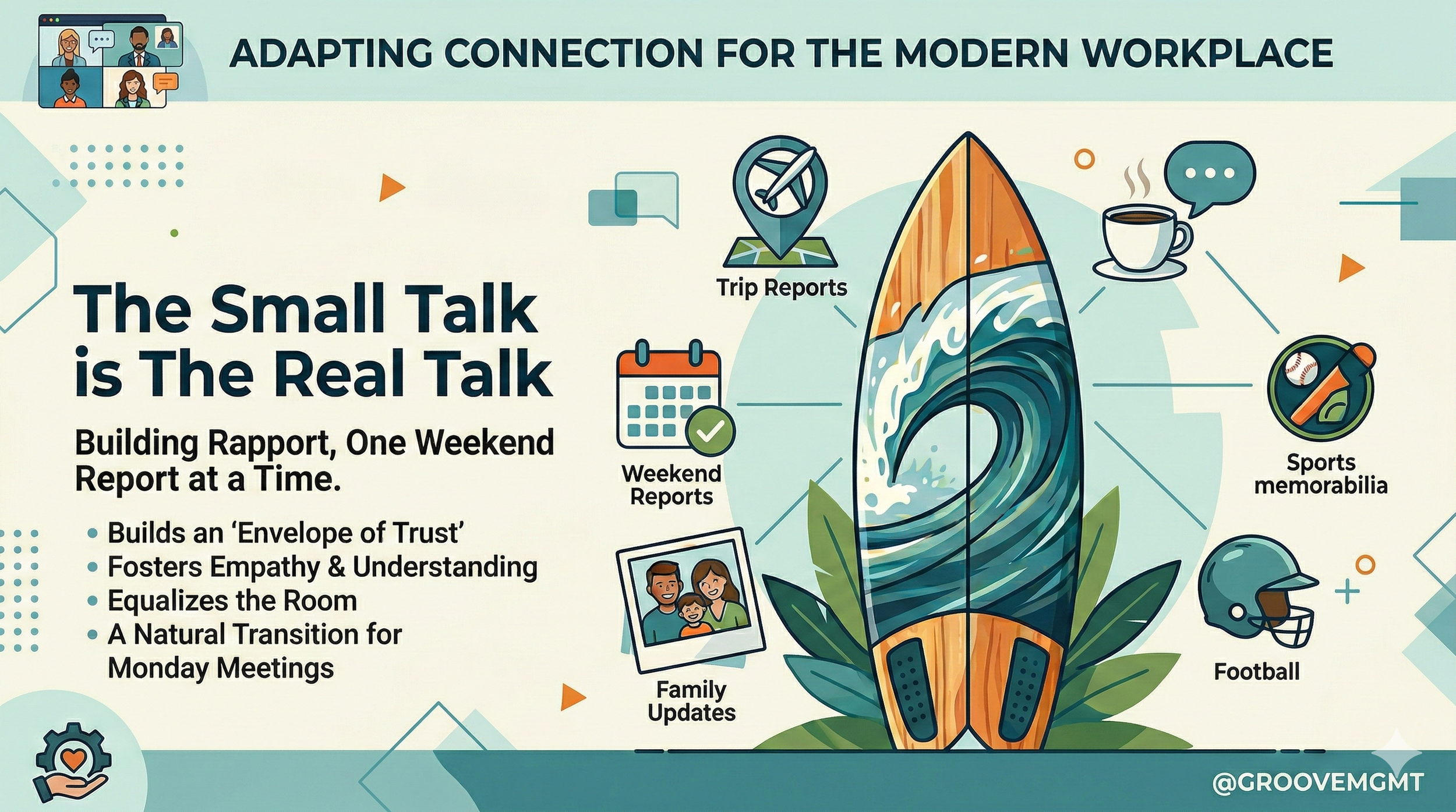
Originally, this literally meant having team members share details about any recent travel or vacations. Over time, it evolved into a broader weekend report where team members would go around the room and discuss what they did over the weekend, share family updates, or talk about other non-business topics. For example, Eric Schmidt (former Google CEO) would often project a Google Map on the screen to show where he had traveled and share interesting cultural or personal observations with the team before discussing Google's business.
The Importance of the Icebreaker Campbell believed these informal check-ins were a strategic necessity, not just pleasant fluff. He championed them for a few key reasons:
Building an "Envelope of Trust": Sharing personal stories helps colleagues see each other as well-rounded humans, not just coworkers. This familiarity builds the psychological safety required for high-performing teams to debate fiercely without making it personal.
Fostering Empathy: When team members know what is going on in each other's lives outside the office, they approach conflicts and collaborations with much more empathy and patience.
Equalizing the Room: By starting the meeting with a topic where everyone is an equal expert (their own life), it gets every voice in the room speaking early on. This makes it much easier for introverts or newer team members to participate when the meeting shifts to tough business decisions.
A Natural Transition: It serves as a mental bridge, allowing the team to transition smoothly from their weekend mindset into the collaborative, high-stakes work of the week.
In a world obsessed with speed and leadership focused on “getting down to business,” too many organizations overlook the importance of human connection. Once again the small talk is the real talk. When individuals find common hobbies, common challenges and the love of similar places, sports and foods they build bonds. This starts with having a curiosity and a desire to learn about others.
While Bill Campbell mastered the icebreaker in the physical boardroom, modern leaders must consciously adapt these techniques for the screen. It is much harder to do this on video calls, yet not impossible. I am very opposed to virtual backgrounds as they are sterile and lack character in most cases. Show me your real home, your office and your surroundings. The natural background provides a glimpse into who you are.
Recently, I was on a coaching call with a client who sits in front of his bookshelf, and I often find myself staring at his family photos, sports memorabilia, and book titles. On a recent call I noticed some of the books had moved around. The book staring at me was titled Collapse, by Jared Diamond. We had a quick laugh about it as he rearranged his shelf.

My background is a piece of artwork. It is a handcrafted surfboard that has a photo of Teahupo'o, the famous surf break. It was my 50th birthday gift from my wife, Brita, and daughter, Olivia. I often get asked about the surfboard. It is a great conversation starter. We all need more of this. It helps us form bonds and find points of connection.
Spending a bit more time on getting to know people will go a long way. It fosters trust, it builds camaraderie, and it makes navigating disagreements and difficult situations much easier. It is a lot easier to work with people you like or at least tolerate than those that you dislike. Finding that common ground strengthens relationships even with people who you have peripherally known for several years but never taken the time to really get to know.
A challenge to you in the coming days: make the small talk the real talk. See where it takes you and your relationships.