
Winning the Talent Championship: Why Forwardfilling Trumps Recycling
Imagine trying to win a championship without the ability to draft, recruit, or trade for new players. The team you have is the team you must work with for the foreseeable future. This strikes me as a recipe for disaster, not the formula to build a winning team.
Yet, this is the exact approach being employed by companies of all sizes and across all industries. While the recent economic uncertainty has caused many corporations to take defensive measures to protect their bottom line, including rigid hiring freezes, the "scars" of the pandemic and other financial downturns have led to a persistent and dangerous trend: talent recycling.
The Danger of the Insular Approach

This has been a pet peeve of mine for years. I have long advised that while organizations should look to cut costs, they should freeze headcount, not hiring. The concept is to keep headcount at a set level but continue to recruit in an effort to upgrade talent and build the employment brand.
When talent is recycled—meaning any departures are filled exclusively with internal moves—the net positive effect is diminished. Even a talented internal team can become frustrated by such an insular approach. People want to be part of a winning team, and working with new people with diverse experiences from outside the company and industry is what drives engagement and higher performance.
The Rising Tide: Why Balance is the Ultimate Performance Multiplier
While external talent provides the disruptive spark needed for reinvention , a truly elite organization understands that this isn't a "one or the other" choice. There must be a balanced approach to talent acquisition that considers the benefits and the risks of filling positions from the outside.
Promoting from within rewards loyalty and preserves the cultural fabric that makes a company unique. However, when you pair those rising internal stars with proven, high-caliber talent from the outside, you create a "rising tide" effect. This combination improves performance across the board for several reasons:
Healthy Competition: The introduction of "championship-level" talent raises the bar, challenging internal high-potentials to elevate their own game to match new standards.
Knowledge Transfer: Internal veterans understand the "how" of the company, while external hires bring the "what else" from the broader industry, creating a richer learning environment.
Combatting Stagnation: A purely internal focus risks "organizational inbreeding," where ideas become repetitive; a balanced approach ensures the culture remains both stable and innovative.
Stop Backfilling, Start "Forwardfilling"
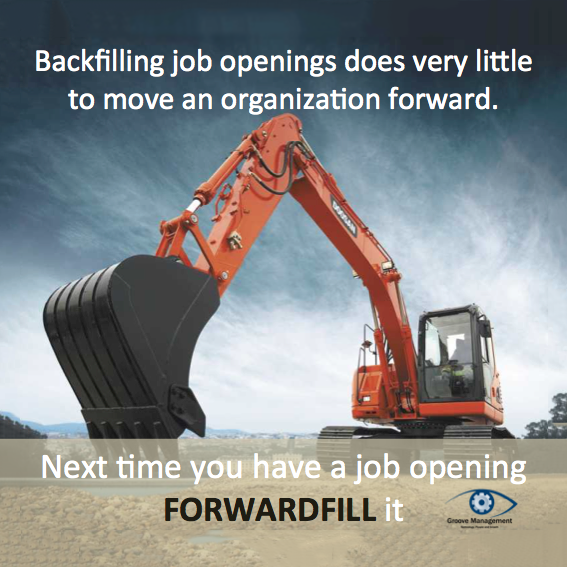
When faced with an open position, organizations need to look to forwardfill the role rather than backfill.
A Forwardfill Strategy is a proactive approach where:
The future needs of the organization are assessed.
The role is redefined for where the company is going, not where it has been.
A balanced slate of internal and external candidates is considered to weigh the benefits and risks of each.
In industries being disrupted by emerging technologies—like the AI and digital shifts we see today—external talent is vital. Outsiders bring fresh perspectives, disruptive ideas, and approaches that have not been considered. This is how progress is made and how companies reinvent themselves. Reinvention almost never happens without outside influence and fresh thinking.
A Tale of Two Strategies
The recipe for a championship team always includes new leadership and fresh talent. Consider the Tampa Bay Buccaneers; they would never have won Super Bowl LV had they not recruited Tom Brady and others. That infusion of new thinking didn't just bring better skills—it improved the performance of everyone already on the team.
Contrast this with a recent announcements from some large public companies. Despite major reorganizations and the retirement of key senior executives, the companies decided to move several people into new roles without a single external hire. This speaks volumes about a lack of focus on talent strategy.
The Bottom Line
Talent matters. It is one of the key differentiators between high-performing companies and the rest. Pairing rising internal talent with proven talent from the outside is the key to boosting performance.
Those organizations that focus on fielding the best possible team—rather than the most convenient one—will always outperform the competition, whether in sports or in business.