
We can all probably agree that in the corporate world, we spend way too much time in meetings. There are several contributing factors, but underpinning many is the desire for creating an inclusive culture. Inclusion and meeting attendance fictitiously go hand in hand. If you are not in a meeting, are you being excluded? Probably not, but for fear of excluding people, meetings get bloated with unnecessary attendees.
A complicating factor is the way meetings are often scheduled. Email distribution lists are an easy way to send out invites, but this approach is fundamentally flawed. For example, when members of the team based in Asia Pacific and Europe log in to a 3pm Pacific time meeting about a US-specific issue, you quickly realize the distro list was not the right way to choose the attendees.
First rule: never use a distro list to invite participants to a meeting. Instead, choose the people who will add value regardless of their title or position.
The Crisis of Meeting Ineffectiveness
The reality of how we spend our time at work is alarming. In fact, time is our greatest equalizer, and how we utilize it directly correlates to our individual and organizational success. In my executive coaching, I frequently discuss the concept of Return on Time (R.O.T.) as a way to manage priorities and evaluate meeting investments.
When we audit meeting frequency and quality across organizations, the data reveals some stark realities:
40% of the workweek is spent in meetings.
Only 40% of meetings feel truly valuable.
40% of meetings could have been an email.
These numbers highlight that we are drowning in unproductive meetings that consume our time and stifle our R.O.T.
The Great Debate: One-on-One vs. Team Meetings
During a recent executive coaching call, a coachee asked me my opinion about one-on-one meetings. I told him I was in favor of them.
Some leaders have famously sworn off one-on-one meetings. Brian Chesky from Airbnb recently stated, "I don't believe in one-on-ones, and almost no great CEO in history has ever done them." He noted that the traditional model is flawed because the meetings lack structure.
Instead, Chesky, echoing Nvidia CEO Jensen Huang, prefers group meetings so that "everyone can be part of the solution and get the wisdom." The logic is that centralized group meetings create a transparent record of who was in the room and how a decision was made, preventing a hub-and-spoke model where everything flows strictly through the CEO.
It sounds great in theory, but in practice, it is often flawed.
I have witnessed too many executive team meetings that basically turn into public one-on-ones. The CEO goes around the table asking each team member to provide an update. This update turns into a one-on-one in front of their peers, sometimes including tough feedback or uncomfortable banter while everyone else sits there multitasking, waiting for their turn on the hot seat.
I much prefer one-on-one meetings. By handling updates individually, the format of the team meeting can shift from a status update to a true problem-solving or planning session.
The Meeting Matrix
To simplify the one-on-one meeting context and evaluate its R.O.T., I use a simple matrix. There are four potential outcomes for a one-on-one meeting:
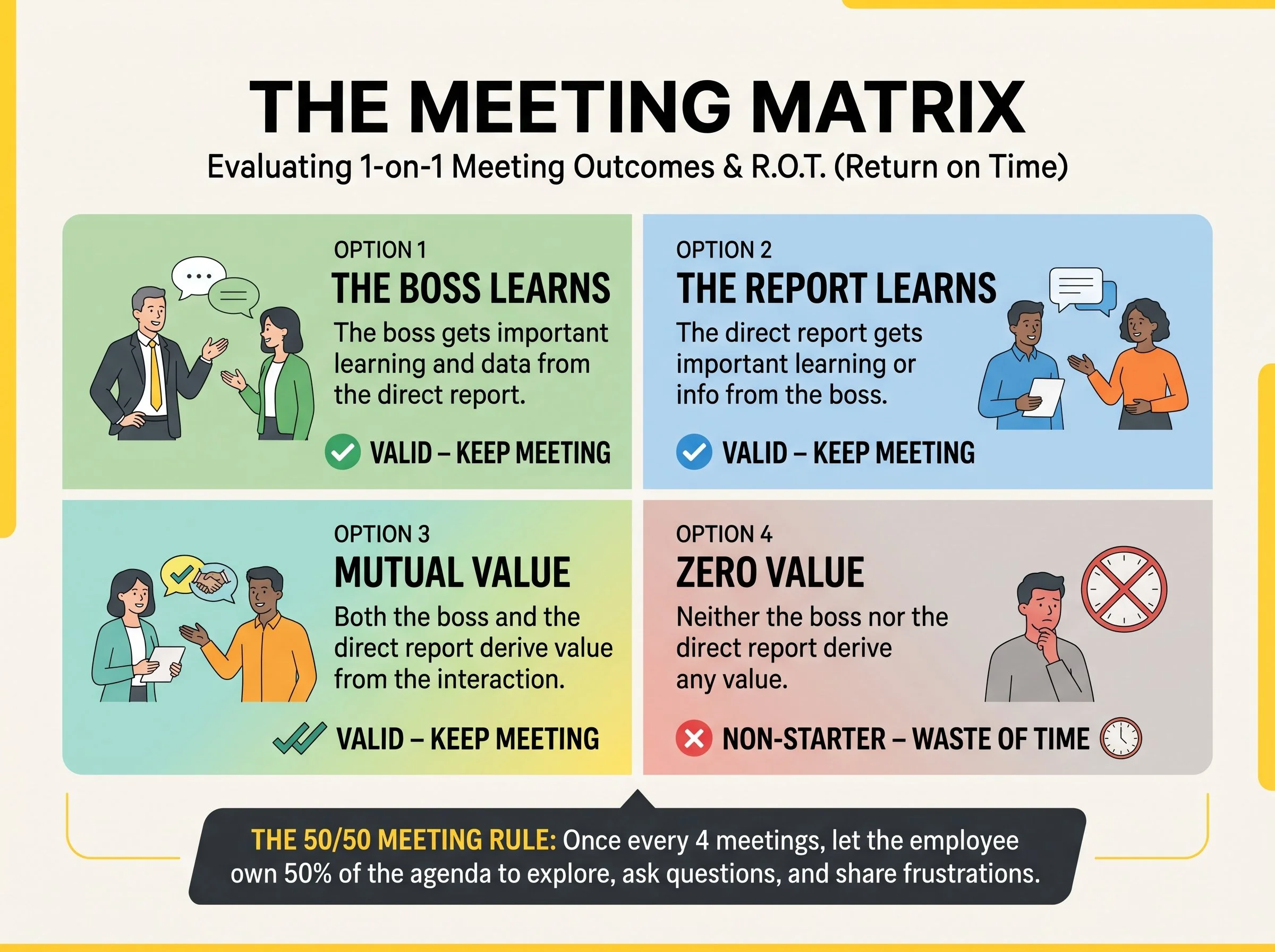
Options 1-3 are all valid reasons to continue holding the meeting. Option 4 shows that the meeting was a waste of time and of zero value.
The 50/50 Meeting Tool
Another direct report meeting tool that I have found highly effective is the 50/50 meeting. At least once every four meetings, the manager should structure a one-on-one where the direct report owns 50% of the agenda.
This creates time and space for the employee to drive the conversation—to ask questions, explore career development, or share frustrations. If the employee doesn’t have anything on their agenda, then the meeting ends short. This way, the employee knows that once every four meetings they have dedicated space to bring up topics of their choosing.
Meetings won’t go away, but there are several ways to make better use of the time. Whether you are auditing your weekly schedule or evaluating a specific one-on-one, the Meeting Matrix is a helpful audit tool to ensure you are maximizing your Return on Time.
This meeting value matrix is a simple tool to apply as a meeting post-mortem. It helps determine if a recurring meeting is worth the time on the calendar.