
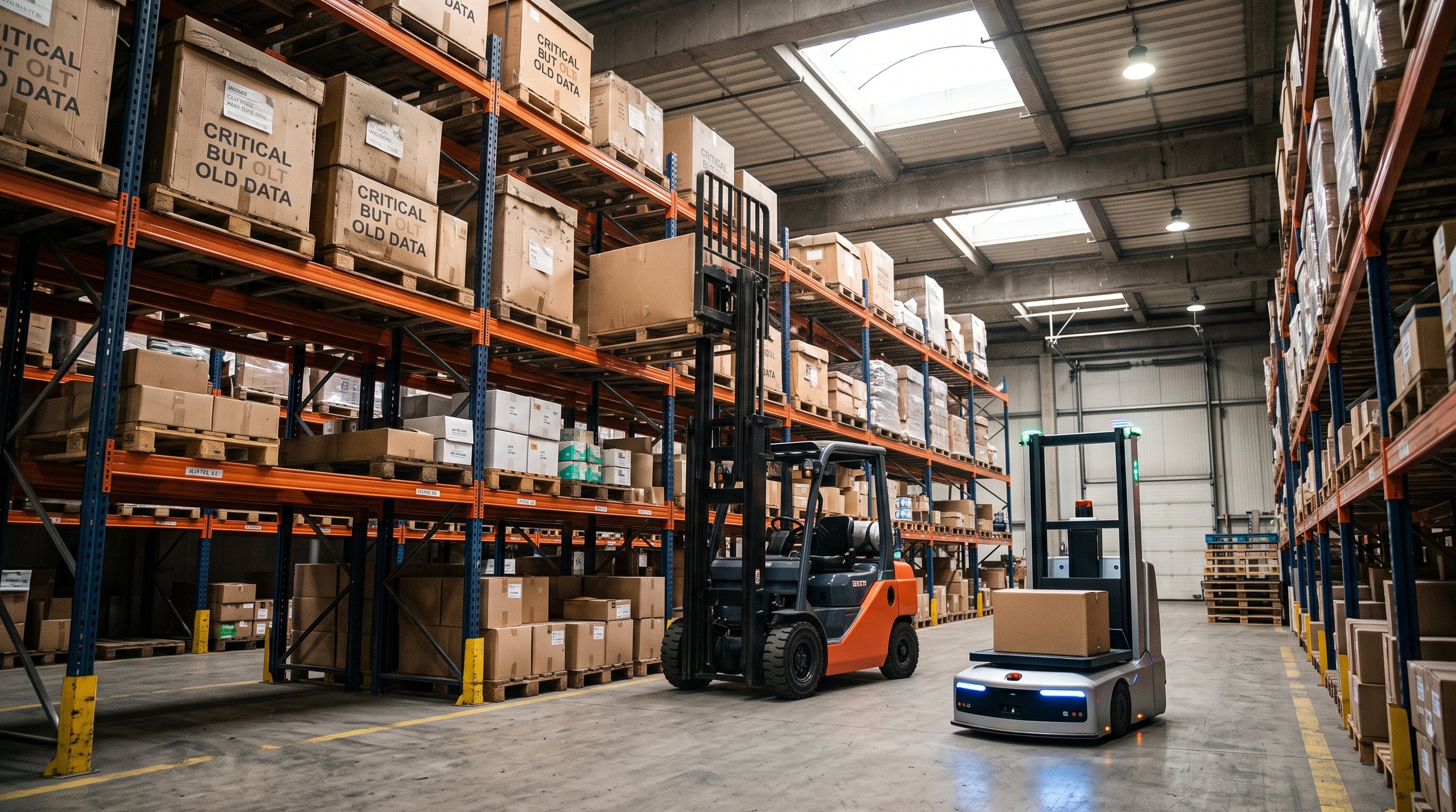
The old vs. new warehousing strategy.
Artificial intelligence is fundamentally rewriting the rules of value creation across every sector of the economy. But one area in particular is undergoing a quiet, massive revolution: big data.
For over a decade, executives have been sold on the promise of monetizing big data. The prevailing wisdom was simple: the larger the dataset, the more value to be unlocked. Yet, most companies simply amassed massive digital stockpiles, unsure of how to actually put it to work. They built data warehouses.
If you compare a traditional data warehouse to a physical warehouse for retail goods, the limitations become clear. In a physical warehouse, a company inventories its products on shelves. For operational efficiency, the highest-volume, fast-moving products are prioritized and placed in the most accessible locations. The aging inventory, the data that does not move is pushed to the back corners and higher racks where it is seldom accessed.
This is exactly how companies have historically managed their data. The frequently queried operational data lived on fast, expensive servers, while the deep, historical data was pushed into "cold storage," gathering digital dust.
The AI Paradigm Shift
Now, imagine a physical warehouse where the placement of the inventory no longer matters because an automated product picker can touch each and every shelf simultaneously, with zero lag between picking a fast-moving item and a slow-moving one.
In the age of AI, this is no longer a metaphor. The bots and AI agents do not just crawl the frequently accessed "hot" data; they have the computational capacity to crawl all of the data in the warehouse with each query. This fundamentally changes the nature of the storage facility. It transitions the warehouse into an active data engine.
All of the data is put to work each and every day. Because these AI models can process the enormous, unstructured size of the entire dataset efficiently, the queries yield vastly different, more accurate, and highly contextual results.
The quality of the insights is directly correlated to the amount of data processed. The more data an AI model can review, the more precise its inferences become. For instance, analyzing weather data from the past year provides a baseline, but analyzing weather data from the past 100 years yields a statistically significant, predictive output. If that historical data is trapped in the equivalent of a dusty box on the back top shelf of a warehouse, it will never be retrieved. Letting AI power your data makes everything instantly accessible, and the resulting business intelligence is game-changing.
Data as a Strategic Asset: The Google Play
We are already seeing this shift from passive storage to active utility play out in high-stakes corporate strategy. It was recently announced that Google is purchasing Spirit Airlines' data in a bankruptcy auction for $10 million to train its artificial intelligence model, Gemini.
Google is not buying this data to put it on a digital shelf. They are buying decades of internal operating history to train their AI models on incredibly complex business workflows, dynamic pricing strategies, and operational decision-making within the aviation sector.
Google is transforming the defunct Spirit dataset into an active engine, powering more sophisticated AI rather than letting it sit idle.
The Leadership Mandate
The question for executive teams is no longer, "How much data are we storing?" The question is, "Are we running a warehouse, or are we running an engine?"
If your data is still segmented into hot and cold storage, waiting for human analysts to pull specific reports, you are operating a legacy warehouse. The organizations that will dominate the next decade are those that treat their data as a continuous, active fuel source, putting every single data point to work, every single day.