We analyzed 336 leaders across 19 companies we’ve worked with. As a group they are bold, gut-led, and biased toward action.
How this started
Brian, our founder, asked me a simple question this fall. We've used the REACH profile with most of our clients for years. Had anyone looked at all the results together?
Nobody at Groove had. So I pulled nearly every profile completed through Groove since 2022: 336 leaders from 19 client companies, plus our own team and one leadership program that brings together people from several companies. People someone decided to invest in.
REACH is a leadership assessment. It looks at where you're comfortable and how far you can stretch when the situation calls for it.
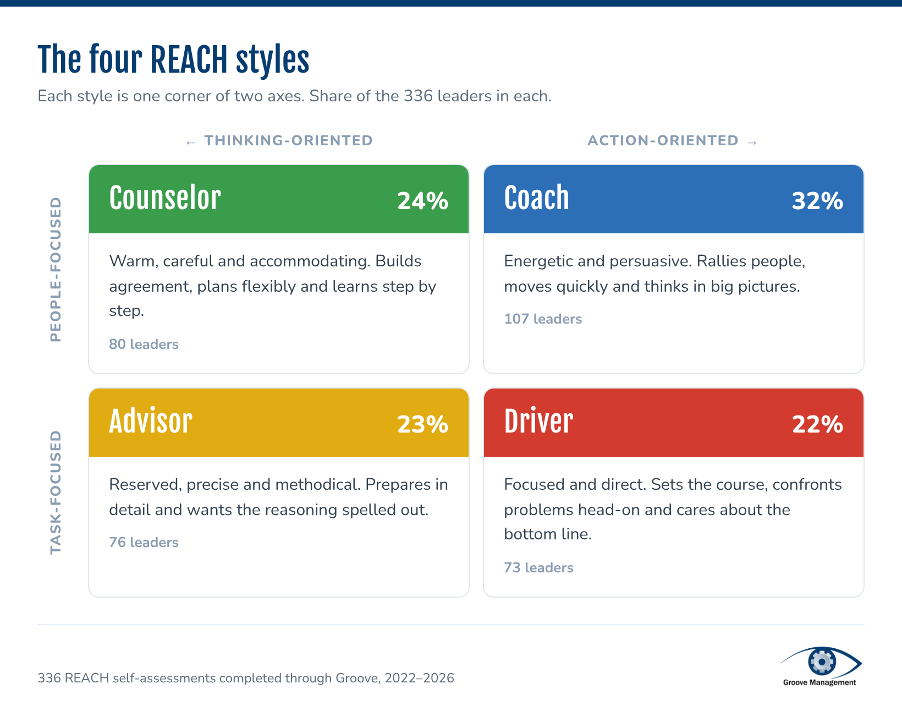
You get a home style: Driver, Coach, Counselor, or Advisor. You also get a position on ten scales, each running between two opposites such as cautious and bold, and a measure of your “reach.” Can you act with more urgency, offer more support, or take a more methodical approach than comes naturally to you?
Three scales stood out: trust, boldness, and instinct. This reveals a potent story about how modern teams operate, or at least the teams that Groove Management has the privilege of working with.
Trust, The “First Team” and Working With vs. For
The strongest lean in the data is toward trust. 78% of these leaders give people the benefit of the doubt. Four in ten sit at the far trusting end of the spectrum, while only one in sixteen sits at the far skeptical end.
A generous room. The person who holds back trust is likely to be in the minority.
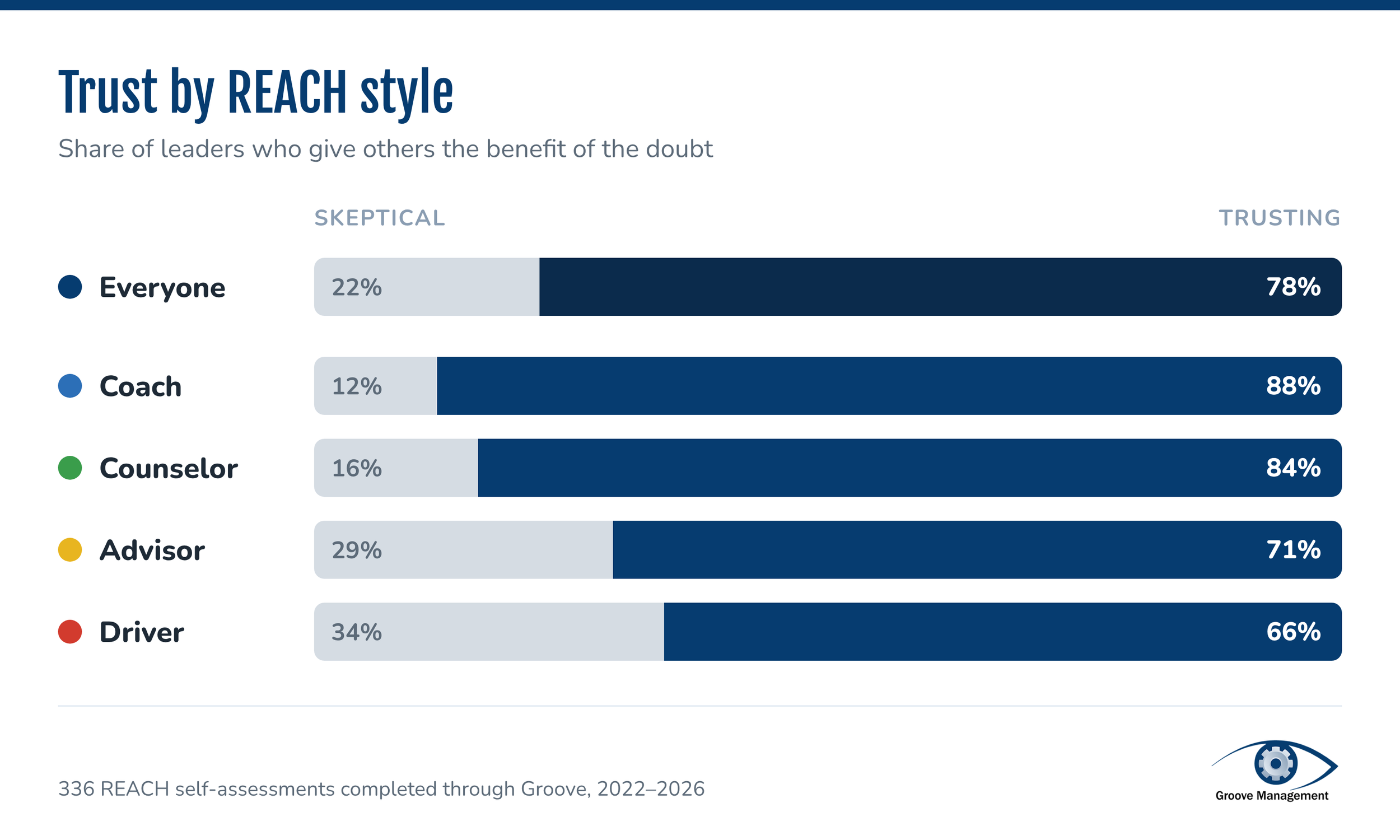
Trust follows the people line, not the pace line. Coaches and Counselors, the two people-focused styles, are the most trusting. A third of Drivers lean skeptical. Even so, most Drivers still give people the benefit of the doubt.
Trust barely varies by company. Once you account for the mix of styles, only one company, a manufacturer, clearly stands out.
There’s an obvious appeal to leading people who give each other the benefit of the doubt. Less time proving your intentions. More room to get on with the work. Amy Edmondson, whose research put psychological safety on every leadership team's agenda, draws a useful line here. Trust is giving others the benefit of the doubt. Psychological safety is believing they'll give it to you when you take a risk, like admitting a mistake or saying you're unsure.
The question underneath: this is a self-assessment, and “others must earn my trust” is a hard box to tick. Some of that 78% is who people are. Some may be who they'd like to be. And trust alone doesn't tell us how carefully anyone checks. But in a room where most people start with good intent, what happens when someone says, “I'm not sure”? Worth knowing whether the group hears them out.
The Groove Perspective: This default to trust is the mandatory prerequisite for our "Work With, Not For" philosophy. But assuming good intent is only step one. That trust must be actively harnessed to break down entrenched functional silos. Leaders must use this foundation of trust to build a unified "First Team," where executives stop acting like representatives of their departments and start owing each other true discretionary effort.
Boldness and GTRSD
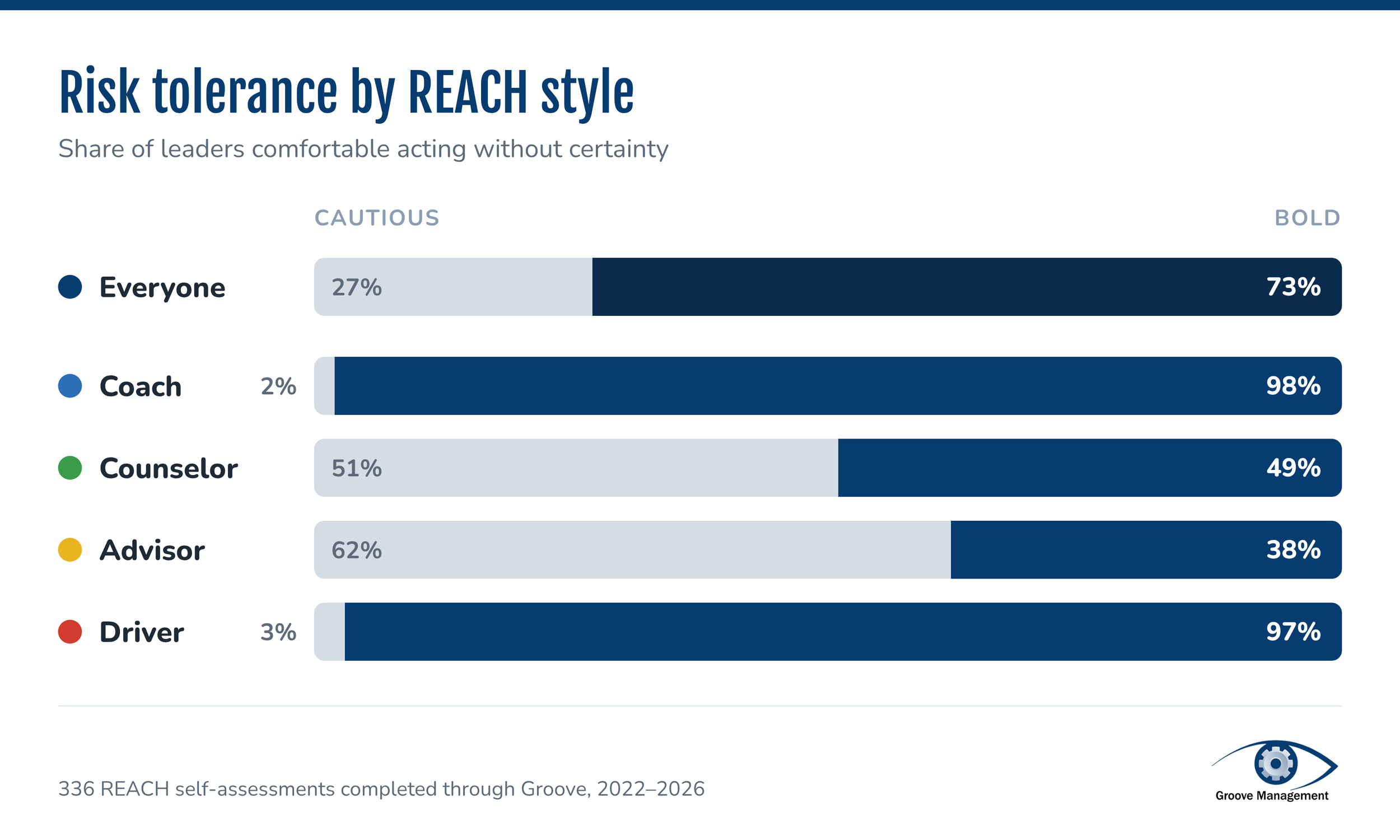
This is a bold, gut-led group. 73% say they are comfortable with risk, preferring to try something rather than wait for proof it works.
Nearly every Driver and Coach leans bold. That’s partly by design: comfort with risk is a big part of what makes someone a Driver or Coach in the first place. The surprise is the other half. The careful styles are only a little careful. Counselors split almost evenly, and only Advisors lean cautious.
The question: bold in action, or bold when asked? Leadership language rewards the word. But the data gives one clue the other way. Within any style, bold people don't rate their own leadership skills higher than cautious people do. Assertive people do. So the bold answer doesn't look like general self-promotion. Whether people act that way when a real decision is on the table is another question, and only the next decision can answer it.
The Groove Perspective: Boldness drives early growth, but it can also become a trap. Bold leaders try to do everything, everywhere, at once. The discipline is narrowing to the part of the market where you can actually win, what we call the Optimal Addressable Market, so the organization can GTRSD: Get The Right Stuff Done.
Instinct and Square Wheels
69% decide by experience and gut feel rather than detailed analysis. This lean is milder than the other two. Few people sit at either extreme. Most go with their gut in an everyday way, not a reckless one.
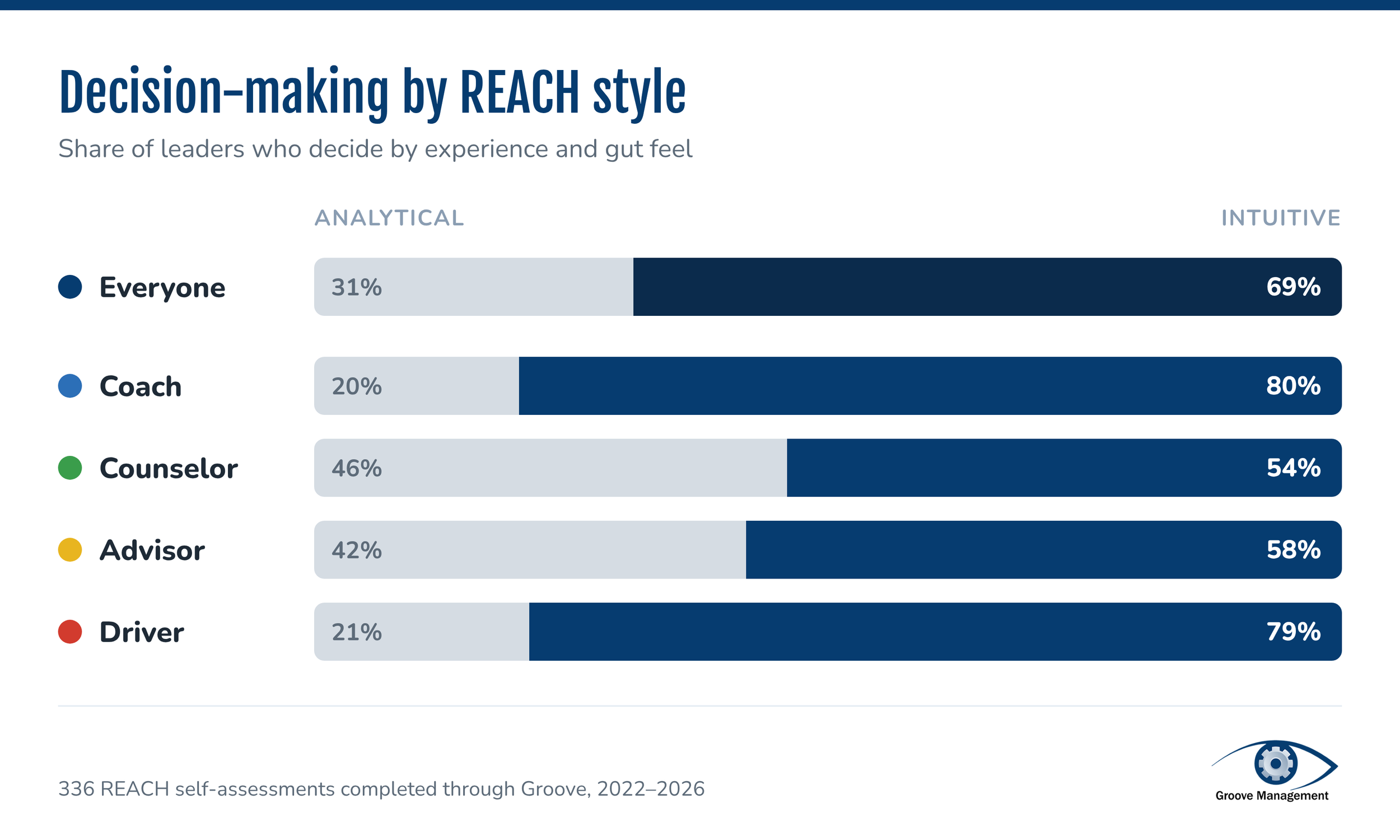
Every style leans this way, even the Advisors, who are supposed to be the methodical ones. So the style label won’t tell you who on your team wants the numbers before committing. Only the Decision-making scale will.
It holds in the data and software companies too. A data-management company we work with has 160 leaders in this study, and two in three decide by feel.
When is that a problem? Daniel Kahneman and Gary Klein, who spent careers on opposite sides of this question, agreed on one thing in a 2009 paper. Instinct works where you get lots of practice and fast feedback. A firefighter’s gut is a library of fires. On a decision you make twice a decade, with results that arrive two years later, the same gut is just a feeling. And it feels exactly the same either way.
Most of a leader’s week is the first kind of decision. A few moments a year are the second. The 14% who want proof and want the data, nearly all Counselors and Advisors, are built for those moments.
The Groove Perspective: This 14% is the vital minority your organization desperately needs to stop the team from pushing the cart with "Square Wheels." Without these objective, detail-oriented voices pressure-testing the assumptions, bold teams will move incredibly fast in the exact wrong direction. Protect your careful, analytical thinkers, whatever their style. They are your strategic guardrails.
Finding Your REACH Groove
Generous, sure, fast. That's the portrait of our clients.
More than half describe themselves as both bold and intuitive: comfortable acting without certainty, willing to trust their own experience. You can see how those preferences might help someone move into leadership.
That’s where reach comes in. Can the bold person slow down when a decision calls for it? Can the careful person move before all the evidence is in? Knowing your own preference is the start. Knowing your team’s is what makes it useful.
Want to see where your team sits? Team REACH maps every leader’s style and scales side by side.
About the data: 336 REACH self-assessments completed through Groove between July 2022 and October 2026, from 19 client companies, our own team and one cross-company leadership program, each person counted once, names removed. Every figure is how people describe themselves. REACH scores people against a large global group of working adults, leaders and individual contributors alike. We’re working with the REACH team on leader-specific comparisons. More on the assessment: REACH Quotient.