
Technology, People and Growth.
That was the tagline that sat below the Groove Management logo for years. It honored the fact that we operate at the intersection of people, technology and growth. Technology drives innovation which changes human behavior and can create growth. It can also create obsolescence. Those that refuse to change, adapt and adopt get disrupted. At Groove Management we have understood this from our start. Personally, I have always been an early adopter. I love new technologies and always crave the latest and greatest even if first generation products are plagued with flaws. Whether that was owning one of the first Apple Macintosh Computers, having a Sony MagicLink personal assistant or having a first generation Blackberry. The products tell a story of where too much of my hobby money has gone over the years.
Being an early adopter while expensive has come with many benefits. I have been quick to embrace new technologies ahead of the curve. I get comfortable trying new things and seeing the possibilities before they become mainstream. Attending CES every five or so years has helped me see the future as well as the evolution of technology. I have incorporated that thinking into the way we run Groove Management. We experiment often with new tools and when we see value we incorporate them into our workflows.
Our clients range from cutting edge technology companies inventing breakthrough cutting edge tech to antiquated manufacturers holding onto the ways they have always done things. This spectrum of clients has afforded Groove Management a front row seat to the adoption curve. We see how companies choose to embrace or resist new technologies. What has clearly changed is the pace of technological innovation and its impact on society.
Gateway vs. Revolutionary Technologies
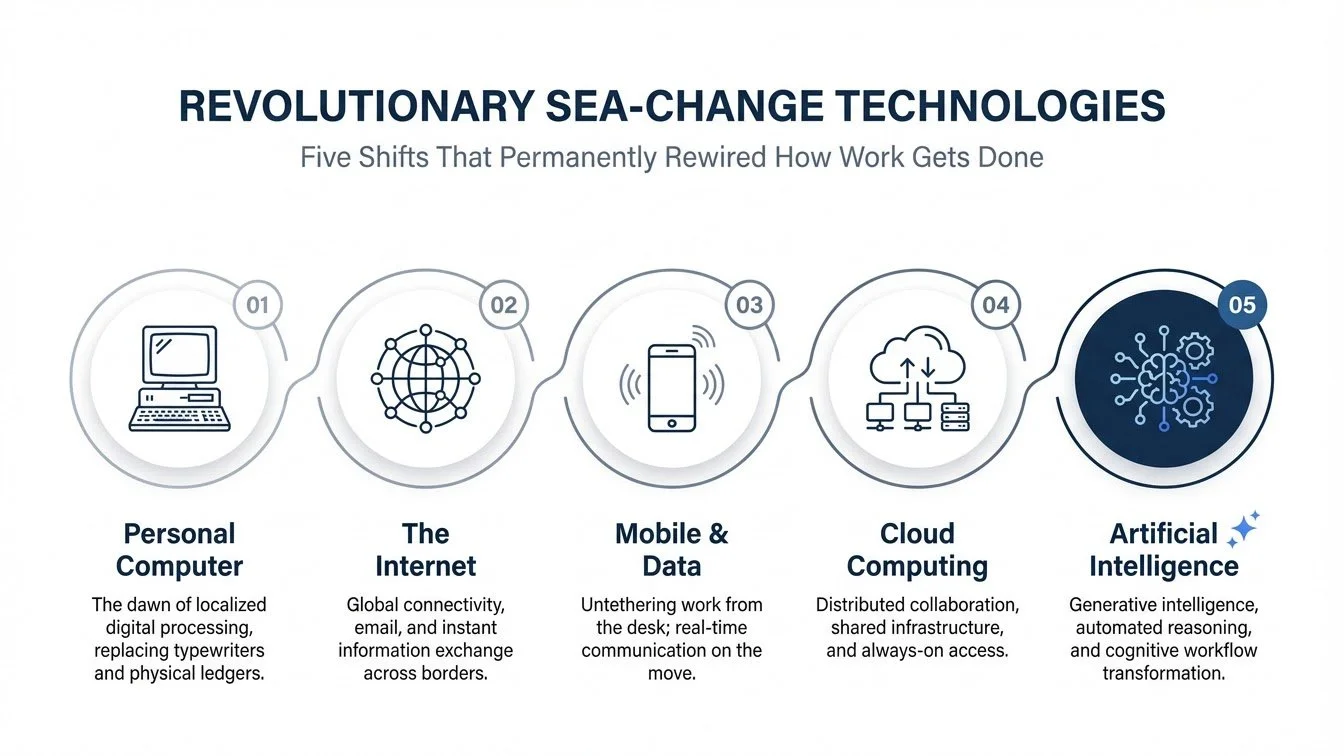
Not every new tool changes the rules of the game. Some are gateway technologies offering incremental improvements or surface-level conveniences that make an existing routine slightly easier without altering how value is created. Others are revolutionary technologies. The personal computer, the internet, mobile phones with data, cloud computing, and now AI belong in that revolutionary category. They reshape how work gets done, who holds leverage, and what competitive advantage looks like.
Revolutionary technologies cannot be treated as a side hobby or a passing fad. Yet I am still amazed by how many capable, high-performing professionals say they haven't really touched AI—often pointing out that AI summaries show up in their Google searches, as if passive exposure counts as fluency. If AI has not fundamentally shifted how you think, research, prepare, or execute on a daily basis, you are missing the point of the shift.
The Adoption Spectrum in Action
The divide across the adoption curve shows up everywhere, often inside the same organization. A close friend of mine who is leading a commercial real estate team in New York City shared that while the younger members on his team use AI all the time, he personally hasn't.
That surprised me, not because he lacks intelligence or drive. He leads at a high level in one of the toughest markets in the world, but because it highlights how wide the adoption spectrum really is. When the next generation is already building speed and leverage with new tools while senior leaders stay on the sidelines, a gap opens up. Over time, that gap turns into a real vulnerability: leaders who don't understand how the work itself is evolving risk falling behind the curve, losing visibility into how their teams operate, or getting disrupted by competitors who moved faster.
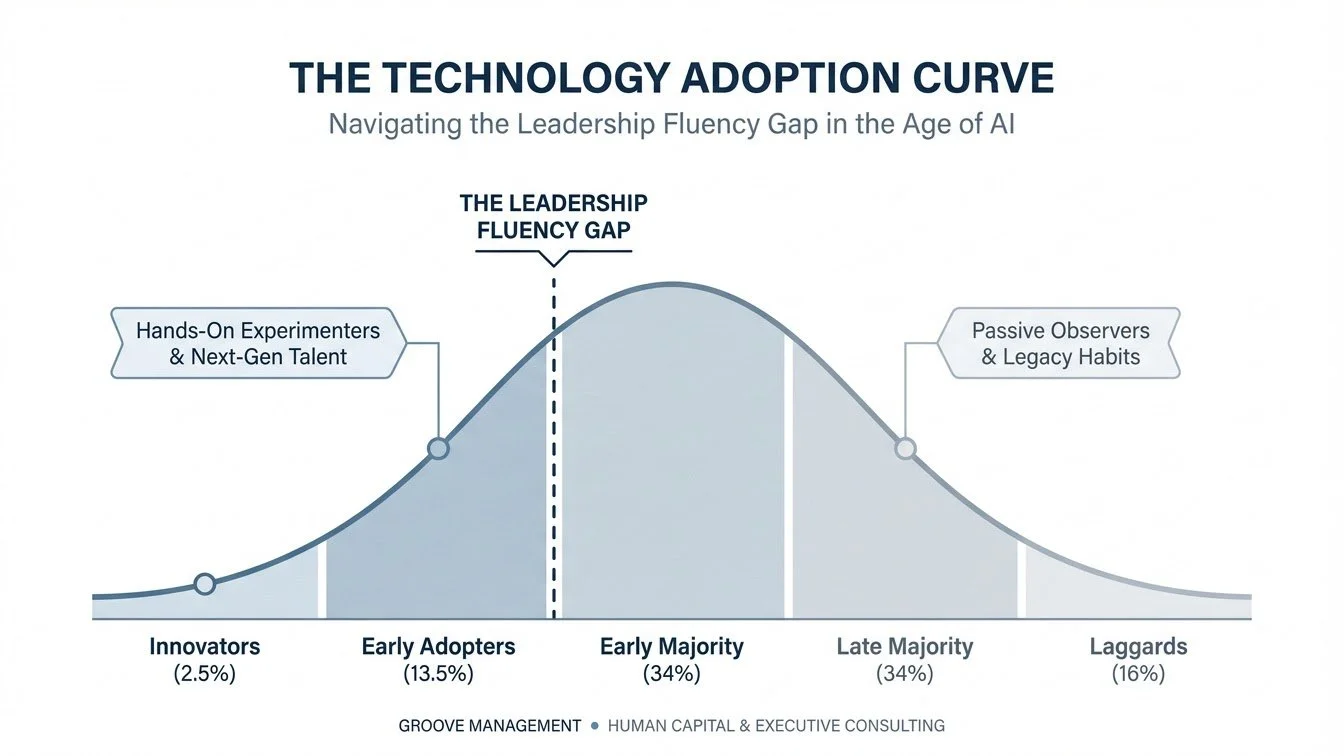
Look at the classic technology adoption curve from the 2.5% of Innovators and 13.5% of Early Adopters on the left, across the Early and Late Majority, to the Laggards on the far right. In previous technological waves, senior executives could safely sit in the Late Majority while IT rolled out enterprise software on a predictable multi-year schedule. That buffer is gone.
With AI, the adoption curve is inverting inside companies. Individual contributors and early-career hires are operating like Innovators, experimenting daily and compressing hours of research, drafting, and analysis into minutes while too many seasoned executives remain parked on the right side of the curve. When a leader sits in the Late Majority on a revolutionary technology, they lose the ability to coach how work actually gets done, spot where processes are broken, or separate real capability from hype. Closing that leadership fluency gap isn't about becoming a coder; it's about moving yourself into the Early Adopter camp so you can lead from experience rather than observation.
Embrace or Be Disrupted
Change or die can sound dramatic, until you watch established players get caught flat-footed by a shift they assumed wouldn't touch their world. Embracing technology doesn't mean chasing every shiny object blindly; it means staying curious, testing where new capabilities create real value, and pairing technological fluency with sound human judgment, trust, and leadership.
Why Tech Fluency Is No Longer Optional
In the past, leaders could treat technology as a separate track, something owned by IT, tested in a lab, or rolled out in systematic annual waves. That separation no longer holds. Today, technological fluency is a core leadership competency, and it goes far beyond knowing which software buttons to click or reading AI-generated search summaries.
If new tools, especially AI have not fundamentally shifted how you think, solve problems, and run your daily work, there is a real risk you are falling behind. Technology alone rarely fails to deliver; transformations stall at the human layer when leaders cling to legacy habits, treat unfamiliar tools with skepticism, or keep teams operating in silos.
We see this dynamic play out directly in executive coaching inquiries. Recently, a senior research leader leading advanced technology work reached out for coaching, specifically looking for a partner who understands how to translate deep technological insights into commercial business opportunities. Leaders at that level rarely struggle with technical brilliance; their real challenge is bridging the gap between breakthrough innovation and organizational alignment, prioritization, and human adoption. Because Groove Management pairs hands-on tech curiosity with deep organizational and behavioral work, we meet leaders right in that tension.
How We Bridge Technology and People
Across our coaching, offsites, and workshops, we look at technology through a human and strategic lens:
AI as a Catalyst for Reinspection: Using AI to challenge unexamined "best practices," spot where teams are pushing carts with "square wheels," and decide what belongs on a Stop Doing list.
Navigating the "Flying Trapeze" of Change: Helping leaders and teams let go of familiar routines and comfort zones before the new way of working feels completely settled.
Focus Over Noise (OAM vs. TAM): Channeling rapid technological capability into the Optimal Addressable Market rather than chasing every shiny object or burning energy across an unfocused Total Addressable Market.
Human Judgment and Trust: Knowing when technology accelerates the work and when human presence, discernment, and psychological safety must take the lead.
How We Walk the Talk at Groove Management
Because Groove Management is a boutique advisory firm, we treat AI as a force multiplier that expands our capacity without ever replacing the human touch. Here is how we blend emerging technology with offline, human-first experiences in our own practice:

The Physical Quote-A-Day Calendar: Every December, we use AI to help curate and organize 365 crowd-sourced leadership quotes into a physical desk calendar we mail to clients and friends complete with weekend prompts designed to get leaders off their screens and reconnected with the offline world.
AI-Generated Offsite Kickoffs: At recent executive offsites, we opened the room with custom AI-generated videos using humor ("I'm sorry you're stuck with Brian today") to disarm the room before pivoting directly to what technology can never replace: trust, candor, and human-to-human leadership alignment.
Physical-Meets-Digital Team Simulations: For a 200-person leadership summit, we designed a custom puzzle challenge where 20 tables raced to build physical puzzle sections, then scanned a QR code to upload photos that assembled a live digital mosaic on the stage screen in real time proving that isolated table speed means nothing unless the whole enterprise connects.
Presence Over Note-Taking (Granola & The AI Mirror): In coaching conversations and client intakes, we let AI handle passive transcription so our coaches stay completely focused on the human being in front of them. Afterward, we use AI to synthesize patterns and review our own coaching questions turning technology into a mirror for continuous self-improvement.
AI-Enabled Coaching Companions: We are actively building proprietary platforms that pair our Groove360 and REACH diagnostics with AI coaching companions, giving executives an on-demand sounding board between live coaching sessions.
A Learning Mindset Wins the Curve
Every new wave of technology brings a mix of excitement, friction, and uncertainty. What separates leaders and organizations that thrive from those that get left behind isn't predicting every gadget on the horizon, it is cultivating a continuous learning mindset, experimenting openly, and leading people through change with clarity and purpose.
For a deeper look at how we bring this approach to executive teams and organizations, explore our Technology, People and Growth page or read more on The AI Prompt for Reinspection.