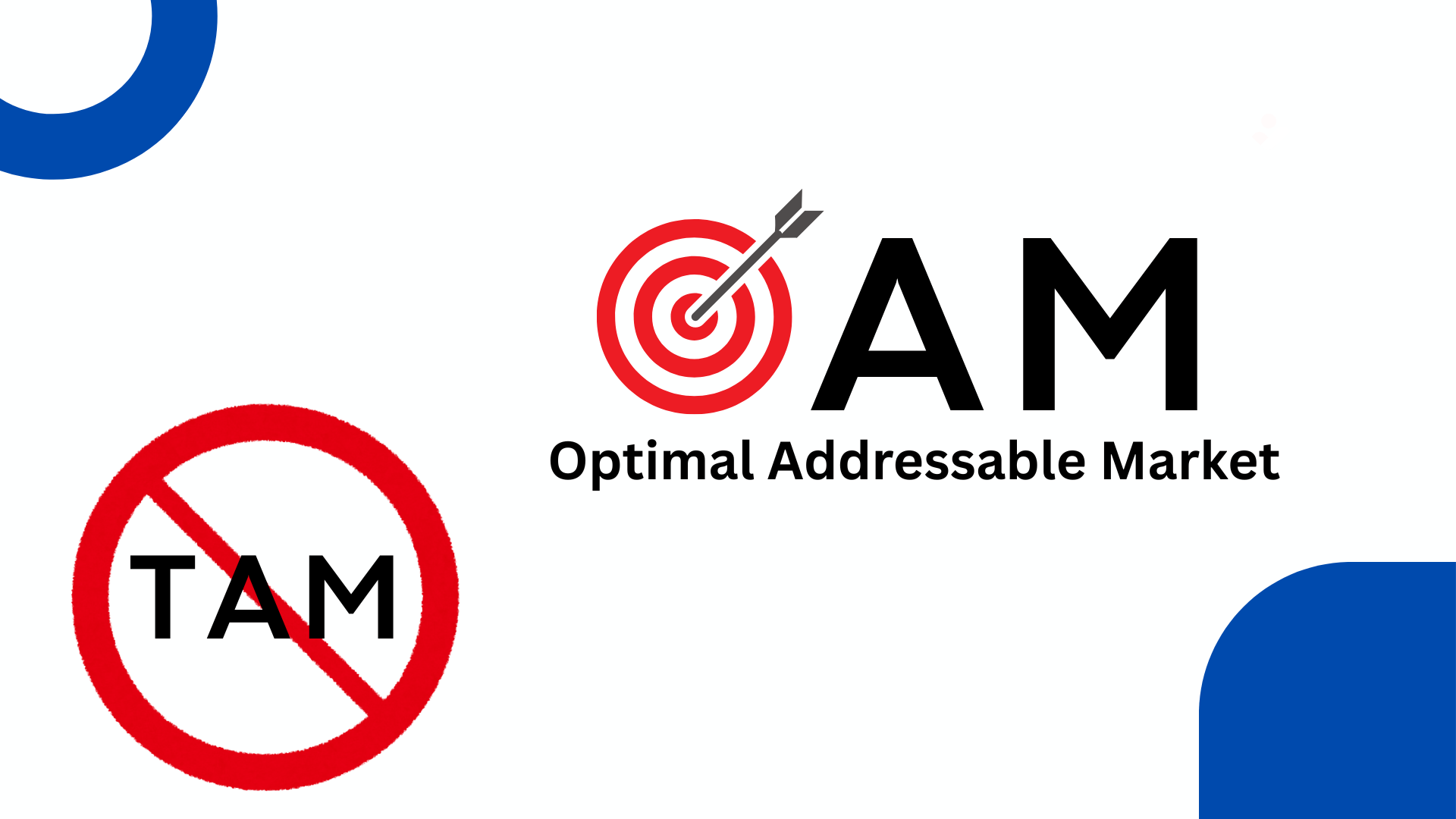
The Death of the TAM: Why Elite Leaders Focus on the OAM
Every pitch deck, strategic planning session, and private equity / venture capital growth playbook seems to start with the exact same slide: The TAM. Leaders love to stand in front of a whiteboard or a board of directors, point to a massive, multi-billion-dollar Total Addressable Market, and make the case that "if we just capture 1% of this market, we will be a massive success."
When I first wrote about shifting your focus from the TAM to the OAM (Optimal Addressable Market) back in 2019, it was a warning against strategic laziness. Today, it is a matter of survival.
As we navigate a business landscape defined by disciplined capital allocation, intense competition, and AI-driven precision, chasing a bloated, ill-defined TAM is the fastest way to burn through your resources. If your leadership team is trying to sell to everyone, you are effectively selling to no one.
The Strategic Market Funnel
To build a truly focused growth strategy, leadership teams must break their market down into three distinct layers:
TAM (Total Addressable Market): The global universe of anyone who could theoretically buy a version of what you sell.
SAM (Serviceable Addressable Market): The portion of the TAM that fits within your current geographical reach, regulatory bounds, and product capabilities.
OAM (Optimal Addressable Market): The ultimate sweet spot. This is the intersection where your highest-margin capabilities perfectly align with a specific customer segment's most painful bottlenecks.
Why TAM is a Dangerous Illusion
A massive TAM is frequently a hiding place for strategic ambiguity. It gives an executive team a false sense of security while diluting their execution.
Think of it like the commercial food and hospitality sector. If you are an enterprise software company building inventory management tools, your TAM might be "every commercial kitchen on earth." That includes everything from a Michelin-star restaurant in Paris to a high school cafeteria in Ohio, to an international airline catering hub.
If your leadership team tries to build a product, a marketing engine, and a sales force to conquer that entire TAM, you will quickly face catastrophic operational friction:
Your product roadmap will stall out trying to please everyone
Your marketing spend will be diluted and ineffective
Your customer success teams will burn out trying to onboard vastly different user personas
Enter the OAM: Finding Your Bullseye
Instead of chasing the whole universe, high-growth companies find their OAM.
Using the commercial kitchen example, an executive team looking for sustainable, hyper-profitable scale might analyze their data and realize their true sweet spot isn't the entire hospitality industry. It is specifically regional, multi-location fast-casual restaurant groups with 10 to 50 locations.
Why? Because they are too big to use manual spreadsheets, but too small to afford custom enterprise systems
Your existing product solves their exact pain point right out of the box, your sales cycle is fast, your margins are maximized, and your customer retention is nearly 100%
That is your OAM. It might only represent 3% of the total TAM, but it is a market you can ruthlessly dominate.
Moving From Slide Deck to Execution
Defining your OAM isn't just a marketing exercise; it is the ultimate tool for corporate alignment. It provides your leadership team with the operational courage to implement one of the most vital components of execution: The "Stop Doing" List.
When a private equity-backed company is looking to scale toward a major valuation milestone, the temptation to chase every shiny object in the pipeline is immense. But when the entire executive committee is aligned on the OAM, it becomes incredibly easy to identify which deals to walk away from. You stop wasting time on low-margin "whales" that twist your product out of shape, and you stop chasing small, noisy clients that drain your support resources.
Three Questions for Your Next Strategy Session:
The Core Audit: If we look at our top 15% most profitable, happiest, and fastest-to-onboard clients, what specific characteristics do they share?
The Friction Audit: Are 80% of our current operational headaches coming from accounts that actually fall outside our optimal sweet spot?
The Dilution Check: Does our current sales commission structure reward salespeople for hunting within the OAM, or are we paying them to bring home toxic revenue from the broader TAM?
The Bottom Line
Market ambition is a prerequisite for growth, but precision is the key to velocity. Stop measuring your potential by the size of the ocean you are standing next to. Define your optimal pool, build the ultimate playbook to dominate it, and have the leadership maturity to tell the market exactly who you are not built for. I bet starting your pitch deck with a slide like the one below would capture your board or investors attention.