The AI Mirror: Continuous Learning in Executive Coaching
Helping leaders enhance their performance has been my passion for over 25 years. Whether it was heading Organizational Development at The Motley Fool, navigating cross-cultural challenges with Doosan Bobcat executives, or coaching CEOs today at Groove Management, I love seeing people grow and thrive. That growth is deeply rooted in an "improving versus proving" mindset, and recently, I experienced a tremendous breakthrough in my own development.
From Skeptic to Early Adopter

Initially, I was highly skeptical of AI notetakers. I view coaching as a fiercely protected safe space. However, after a poll revealed that 80% of respondents were actually in favor of the technology, I began testing Granola.ai.
The first advantage was immediate: by letting the AI transcribe the conversation, I no longer had to take notes. I could be completely and utterly present for my clients, paying far more attention to body language, tone, and non-verbal communication.
The Ultimate Feedback Loop for Experts
The true "ah-ha" moment came a few weeks later. As an expert authority, it is nearly impossible to get objective feedback on one's own coaching beyond basic client validation. After a particularly heavy session with an executive whose self-esteem had been battered by organizational friction, I asked Granola for a critique of my performance.
The sanitized feedback I received was stunningly precise:
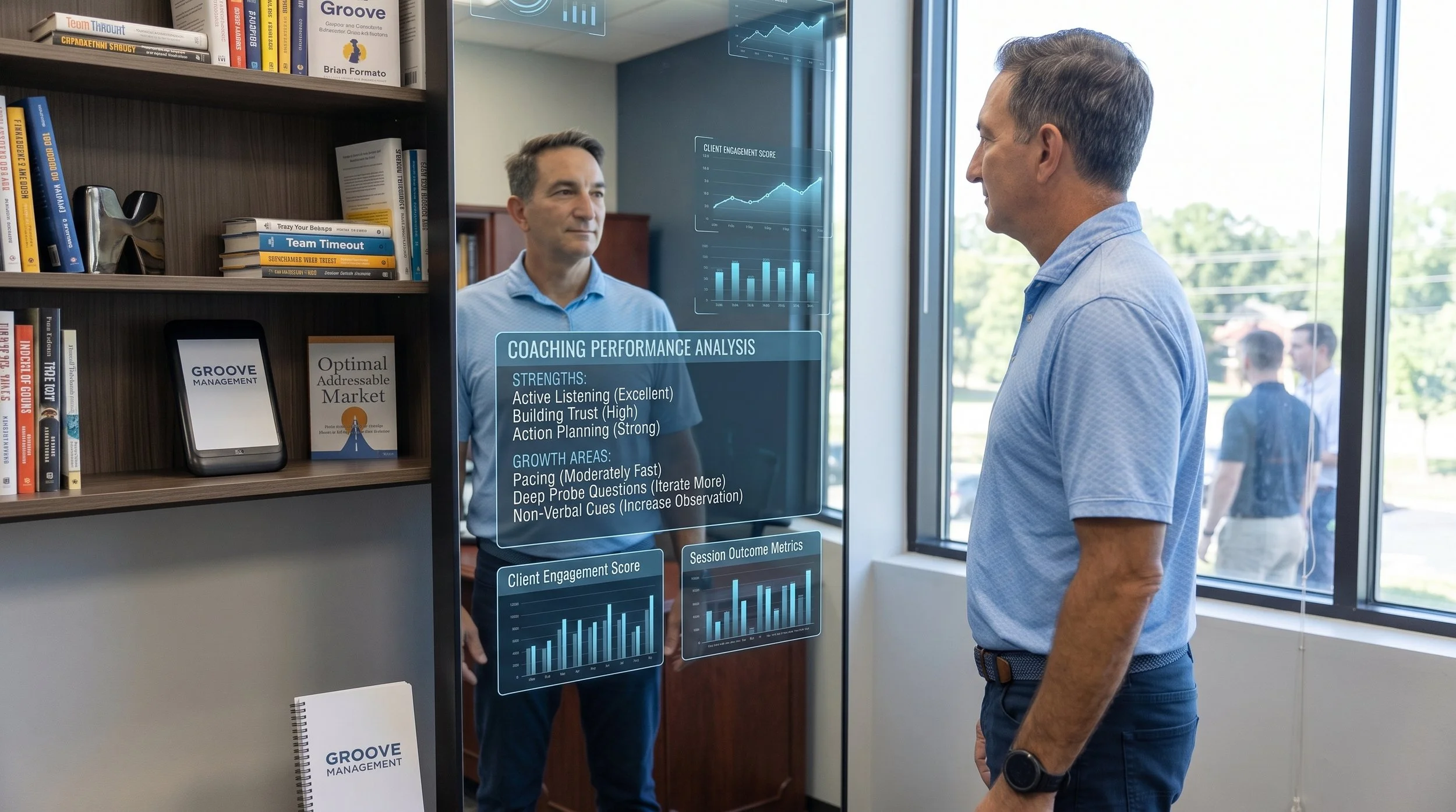
The Strengths: I successfully created deep psychological safety and offered practical reframes, shifting her challenge from a "complaint" into actionable "risk management" language she could use internally.
The Growth Edge: I moved into advising faster than coaching. I generated strong ideas but shifted from listening to prescribing before fully exploring what she most wanted from the conversation.
The Adjustments: I need to separate coaching from consulting more intentionally, use more explicit emotional mirroring, and leave more silence after key disclosures.
Coaching the Coach
As stated above I have always had a tendency to move from coaching to advising. This natural tendency serves me well when leading strategic planning sessions with clients and when collectively problem solving, but it undermines my coaching skills. My role as a coach is to hold the mirror up to my clients, be a good listener and to be Socratic. Years ago I wrote an article titled, The Best Leaders Ask Great Questions The lesson I highlighted in that article that I had learned from a former Goldman Sachs CEO applies to coaches as well. The better I get at asking questions, the more impactful I become as a coach. Much like AI is reliant on a good prompt, a coach is reliant on powerful questions. This new feedback loop of using AI to coach me as a coach is already improving my ability to ask better questions of my coaching clients.
The Vulnerability of the Expert: Working With Instead of For
It takes a significant amount of confidence to invite a machine to critique your work. But modeling this kind of vulnerability fundamentally changes the dynamic of the coaching relationship. Over two decades ago, a classmate gave me a piece of unvarnished feedback that still guides me today. She said, "Brian, I would love to work with you in the future, but not for you".
That hit me hard. But truly absorbing that single piece of feedback fundamentally changed my trajectory and completely reframed the way I view my role as a leader. It taught me that as a leader, your job is to bring out the best in the team and support them.
When I step into a coaching session and immediately rush to give advice, I am falling back into the trap of performing for my clients. I am putting pressure on myself to be the "all-knowing expert" with immediate answers. But when I use AI to openly assess my own blind spots—and when I am willing to be a work in progress alongside the executives I coach—it reinforces the idea that we are on a shared journey. I am working with them to uncover solutions rather than simply handing them a prescription. When you stop asking people to work for you, that is when I am in my groove.
A Breakthrough for All Leaders
The urge to advise instead of coach is a real tension I struggle with. Having it called out—and being handed easy, actionable shifts—is of tremendous value to me. The ability to learn while doing is a massive breakthrough.
This dynamic is incredibly powerful, yet strangely understated and underestimated. If you have not thought about why you lead your team meetings the way you do lately, let AI be the prompt for your reinspection.
The Prompt for Reinspection
To test the power of AI as a reinspection catalyst in your own leadership today, try using an AI notetaker in your next team meeting and give it this literal, copy-and-paste prompt:
"Act as an executive coach evaluating my meeting leadership. Did I create a safe space for dissent? Did I move to problem-solving before fully exploring the team's concerns? Give me two specific behaviors to add to my 'Stop Doing' list."
When you ask AI to evaluate your approach, you often realize that certain prescriptive habits shouldn't just be changed—they should be eliminated entirely. It helps you confidently identify the behaviors you need to add to your "Stop Doing" list, freeing you up to be a more effective, supportive leader.
AI won't replace me because it cannot replicate the distinctly human emotional intelligence required to coach. But by leaning into that human superpower, I can leverage these tools to listen more intently, ask better questions, and continually elevate my craft.
Note: I have been so impressed with Granola's impact on my coaching that I recently became an affiliate. If you want to test it in your own meetings, you can https://go.granola.ai/brian-formato .